RFC 6749 — OAuth 2.0
Authorization code and client credentials grants. No implicit grant. Refresh-token rotation with family tracking.
Making trust programmable.
Security
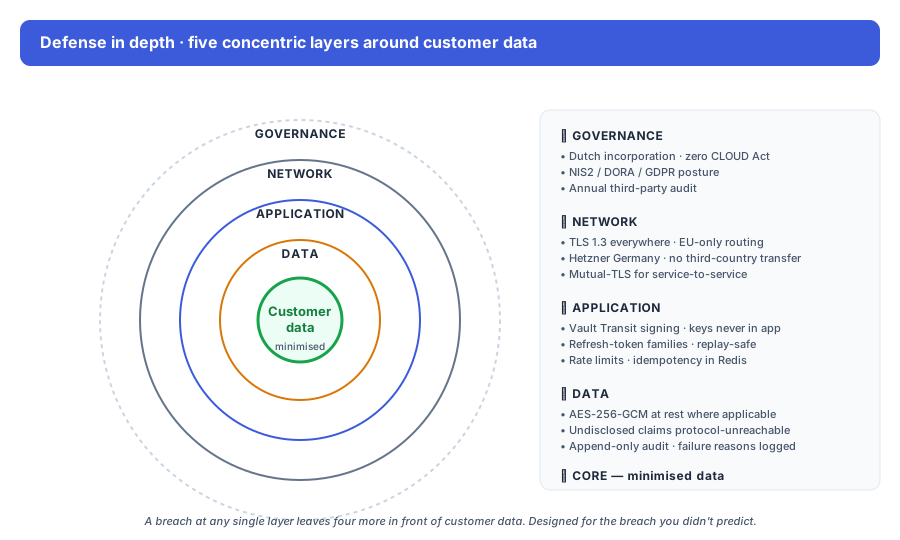
All customer data is stored and processed inside the European Union. Production infrastructure runs on Hetzner, in German data centres (Falkenstein and Nuremberg). No US cloud providers sit in the hot path for authentication, token issuance, or credential verification.
Signing keys for JWT access tokens and OIDC ID tokens live in HashiCorp Vault Transit. Keys never leave Vault — the application calls Vault to sign; the raw key material never touches the JVM process. Credentials stored in Cloud Wallet are encrypted at rest with AES-256-GCM; per-user wrapped keys via Vault Transit are on the roadmap.
Production access is limited to the founders and named on-duty engineers. All admin access is authenticated via MFA-backed SSO. Privileged access is reviewed monthly. There is no shared root account.
We maintain an on-call rotation with a ≤24h customer-notification commitment for P1 incidents (confirmed breach of confidentiality, integrity, or availability affecting customer data). The incident-response runbook is maintained in the team password manager and reviewed quarterly.
We do not currently hold SOC 2 Type I or Type II certification. What exists today: GDPR-compliant data handling, NIS2-aligned controls (documented and self-assessed), and eIDAS-aligned technical architecture for the verifier and issuer products. SOC 2 is on the 2026–2027 roadmap alongside our first external pentest. We would rather tell you the truth now than collect a badge later.
We have not yet engaged an external pentesting firm. Internal red team exercises are run per-release on critical flows — OAuth authorization, token exchange, credential presentation. A first external pentest is planned alongside the SOC 2 work. The broker's red-team demo is a live exercise of protocol-level defences (replay, tampered claim, expired credential, wrong issuer).
A Data Processing Agreement is available on request before you sign a commercial contract. The standard template is SCCs-based EU model clauses with a Thoryn-specific processing schedule. Customer-modified DPAs are accepted subject to legal review.
Implementation claims, not certifications. We build against the specs; we test against them; we publish our conformance. Where we differ from a reference implementation, we say so.
Authorization code and client credentials grants. No implicit grant. Refresh-token rotation with family tracking.
Required on every public client. S256 challenge method. No plain challenges accepted.
Pushed Authorization Requests required for broker flows. Request objects never travel over the front channel.
Selective-disclosure verifiable credentials. Accepted by the broker; issued by Cloud Wallet. Undisclosed claims are cryptographically unreachable.
Verifiable Presentation protocol. The broker's verifier path is tested against the NL reference wallet and the EU reference wallet.
Architecture and Reference Framework alignment for the EUDIW relying-party flow. We track ARF revisions and ship updates without requiring integration changes.
Match your regulation to the Thoryn capability that addresses it. Every row links to a live verification demo.
| Regulation | Binding date | Thoryn capability | Demo |
|---|---|---|---|
| NIS2 Art. 21(2)(d) supply-chain measures | In force | Per-event tenant-scoped audit chain. Queryable via API within 72 hours, without log aggregation. | See it |
| BRZO 2015 / Seveso III | In force | Contractor identity plus 7-year audit-replay through historical JWKS. | See it |
| ISPS / AVSEC (EU Reg. 300/2008) | In force | Multi-employer federation across 200–2000 contractors per day. | See it |
| Wbn (Kernenergiewet) | In force | 10-year cryptographic replay through historical JWKS. Vault Transit signing. | See it |
| CRA | Dec 2027 | Pre-binding evidence-chain support for software supplier credentials. | See it |
| IAEA Safeguards | In force | Audit replay covering inspection cycles. | See it |
| SOC 2 Type II / ISO 27001 supply-chain | Tenant-driven | Per-tenant query API for "who entered rack X at time Y". | See it |
Every row above is satisfied by the same audit chain. One verification path, written once, replayable seven years out.
Every third party that processes customer or site data is disclosed in the subprocessor list — who they are, what they do, and what data they see.
30 minutes with a founder or engineer — we'll walk through your security requirements and answer anything we didn't cover above.