Wallet profiles · Wallet profiles
Age gate — only `age_over_18`
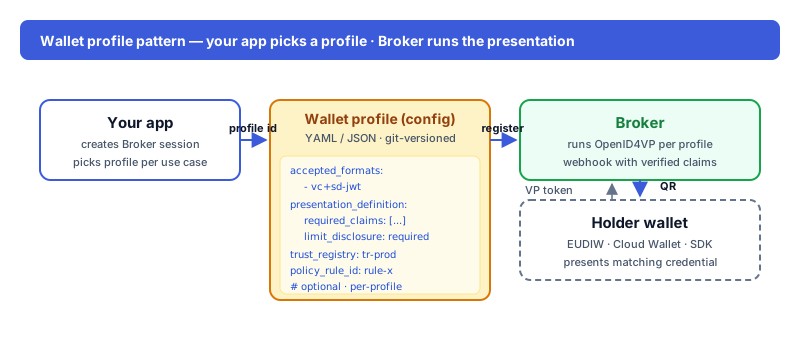
Wallet profile + presentation definition that requests only the derived `age_over_18` claim. Birth date never leaves the wallet.
- age-gate
- selective-disclosure
- gdpr
Tested against:broker: 1.0.0arf: 1.4
Use case
A Dutch online retailer selling alcohol needs proof of majority. Asking for the full PID would be over-collection. The wallet's derived age_over_18 claim is exactly what's required — boolean, audit-friendly, GDPR-minimal.
Wallet profile (YAML)
id: age-gate
name: "Age gate — over 18"
accepted_formats:
  - vc+sd-jwt
trust_registry_url: https://trust.thoryn.org
allowed_issuers:
  - "did:eidas:nl"
  - "did:eidas:de"
  # any qualified PID issuer
session_ttl_seconds: 300
require_holder_binding: true
nonce_required: true
Presentation definition
{
  "id": "age-gate-pd",
  "input_descriptors": [
    {
      "id": "age",
      "constraints": {
        "limit_disclosure": "required",
        "fields": [
          { "path": ["$.vct"], "filter": { "const": "PIDCredential" } },
          { "path": ["$.age_over_18"] }
        ]
      }
    }
  ]
}
The crucial line: limit_disclosure: required. Without it, wallets may disclose the whole credential. With it, the wallet must restrict to the requested fields — and crucially, the derived age_over_18 claim never lets the birth date leave the wallet.
Sample webhook payload
{
  "session_id": "...",
  "vct": "PIDCredential",
  "claims": {
    "age_over_18": true
  },
  "verified_at": "2026-04-25T..."
}
That's it. No name, no birth date, no document number. Your audit log can prove "we verified" without ever holding personal data.
When to use
- Age-restricted retailers (alcohol, nicotine, gambling)
- Any flow where regulatory compliance requires proof-of-verification but not the underlying PII
When not to use
- KYC — you need the full identity, use kyc-pid
- Custom age threshold (over-21) — present a different derived claim
See also
- Broker — Use cases — scenario 4 (age-gate)
- age-over-18 policy rule