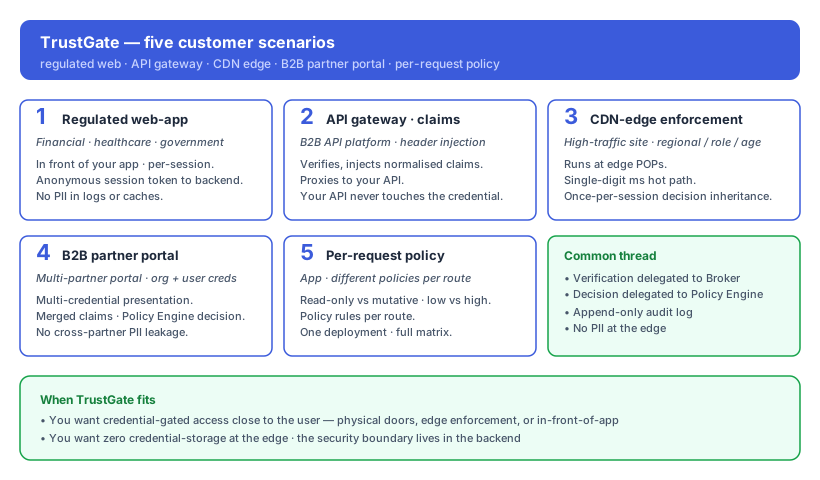
Five scenarios where credential-gated access at the edge beats the alternatives.
Five scenarios where credential-gated access at the edge beats the alternatives. In every one, the "no PII stored" guarantee shapes the architecture.
The five named scenarios with archetype and outcome — pick the closest fit when credential-gated enforcement at the edge is the goal.
1
Regulated web-app access control
Customer: A regulated platform (financial, healthcare, government) that needs credential-gated access without storing credentials.
Outcome: TrustGate in web-mode sits in front of your app. Presentation is verified per-session; your app receives an anonymous session token with claim-level scopes. No PII in logs or caches.
2
API gateway claim injection
Customer: A B2B API platform wanting to inject verified caller attributes into downstream service calls.
Outcome: TrustGate verifies, injects normalised claims into request headers, and proxies to your API. Your API reads the claims without ever touching the credential.
3
CDN-adjacent attribute enforcement
Customer: A high-traffic site that wants to enforce attribute-based access close to the user (regional, role-based, age-gated).
Outcome: TrustGate runs at edge POPs. Attributes come from presentations done once per session; subsequent requests inherit the decision. Latency stays in single-digit ms for the hot path.
4
B2B partner portal
Customer: A portal where each partner organisation has authorised users that must prove both organisational membership and individual credentials.
Outcome: Multi-credential presentations; TrustGate merges claims from both credentials; decision via Policy Engine. No cross-partner PII leakage.
5
Per-request policy injection
Customer: An app that wants different verification policies per request path (read-only vs mutative; low-value vs high-value).
Outcome: Policy rules per route; TrustGate evaluates the appropriate rule before forwarding. One deployment handles the full matrix.