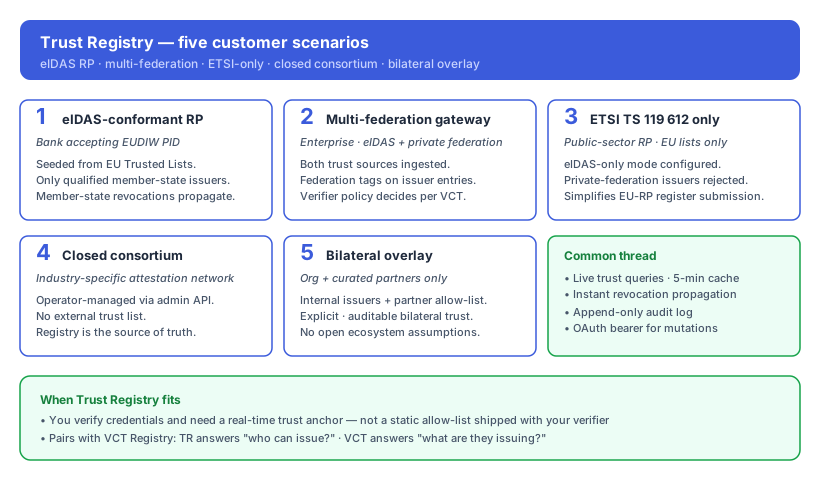
Five scenarios — from eIDAS conformance to closed-consortium trust overlays.
Five scenarios — from public-sector eIDAS conformance to curated bilateral trust.
The five named scenarios mapped to their customer archetype and trust-source posture — pick the one closest to your governance model.
1
eIDAS-conformant relying party
Customer: A bank accepting EUDIW PID presentations.
Outcome: Registry is seeded from the EU Trusted Lists. Broker queries the registry on every presentation; only qualified member-state issuers pass. Revocations propagate from the member state to the registry to Broker within the ingestion cycle.
2
Multi-federation gateway
Customer: An enterprise that needs to accept credentials from both eIDAS and a private-sector federation (e.g. a financial-services consortium).
Outcome: Registry ingests both trust sources; issuer entries carry federation tags. Verifier policy decides which federations qualify for which credential types.
3
ETSI TS 119 612 integration
Customer: A public-sector relying party required to verify against the EU Trusted Lists only.
Outcome: Registry is configured in eIDAS-only mode; private-federation issuers are not accepted. Simplifies the audit evidence pack for EU-RP register submissions.
4
Closed consortium trust
Customer: A closed consortium of issuers (e.g. an industry-specific attestation network) that doesn't use eIDAS.
Outcome: Operators manage issuer trust via admin API. No external trust list; the registry is the source of truth for the consortium.
5
Bilateral trust overlay
Customer: An organisation that has its own issuers + trusts a specific partner's issuers, but not the whole ecosystem.
Outcome: Registry merges the org's internal issuers with a curated allow-list of partner issuers. Explicit, auditable bilateral trust.