Trust anchors, programmable
Compliance
ETSI TS 119 612, eIDAS 2.0, OpenID Federation 1.0, and GDPR — an operator-data-only posture.
Trust Registry is operator-data-only by design. No personal data; all information is about organisations (issuers, federations, authorised VCTs).
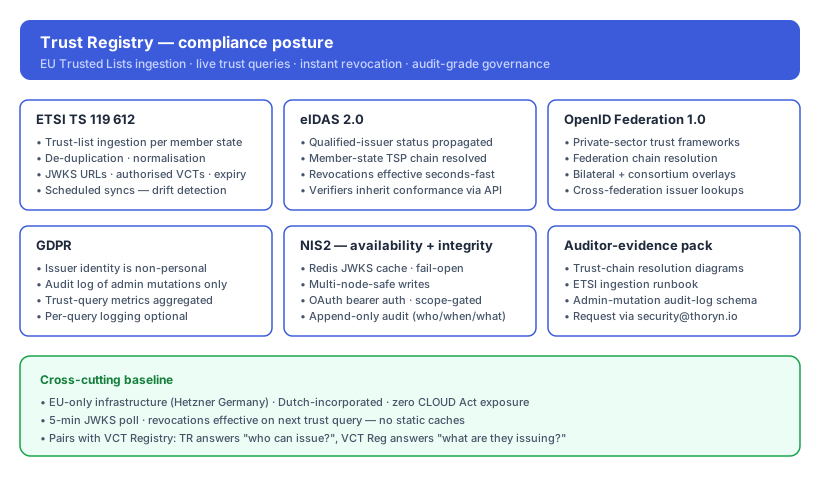
ETSI TS 119 612
The standard governing the EU Trusted Lists — member states publish lists of trust service providers with qualified signing keys. Trust Registry ingests these lists, normalises the shape, and exposes them to verifiers via a standard HTTP API.
eIDAS 2.0
Under Regulation (EU) 2024/1183, relying parties verifying EUDIW credentials must trust only qualified issuers. Trust Registry is the machine-readable surface for that — a verifier that trusts only entries sourced from the EU Trusted Lists is automatically eIDAS-conformant on the trust-anchor side.
OpenID Federation 1.0
For private-sector and consortium trust, Trust Registry supports OpenID Federation chains. An issuer's trust is established by chaining up to a federation root; revocation at any point in the chain invalidates downstream trust. Compatible with the ARF's federation requirements.
GDPR
No personal data flows through Trust Registry — only operator identifiers and signing keys. No Art. 30 processing obligations beyond standard service-operator hygiene. If admin actions are attributed to a person, that's controller-side metadata, minimal by scope.
NIS2 — availability + integrity
Because every verifier calls Trust Registry on every presentation, availability is critical. Horizontal scaling, Redis-backed JWKS caching, Postgres replication, health-check endpoints, Prometheus metrics on resolution latency. Integrity: issuer entries are signed on ingestion where possible; admin CRUD is audit-logged.
Also on Trust Registry
Ready to govern trust?
Request access to stand up your own Trust Registry and connect it to Broker.